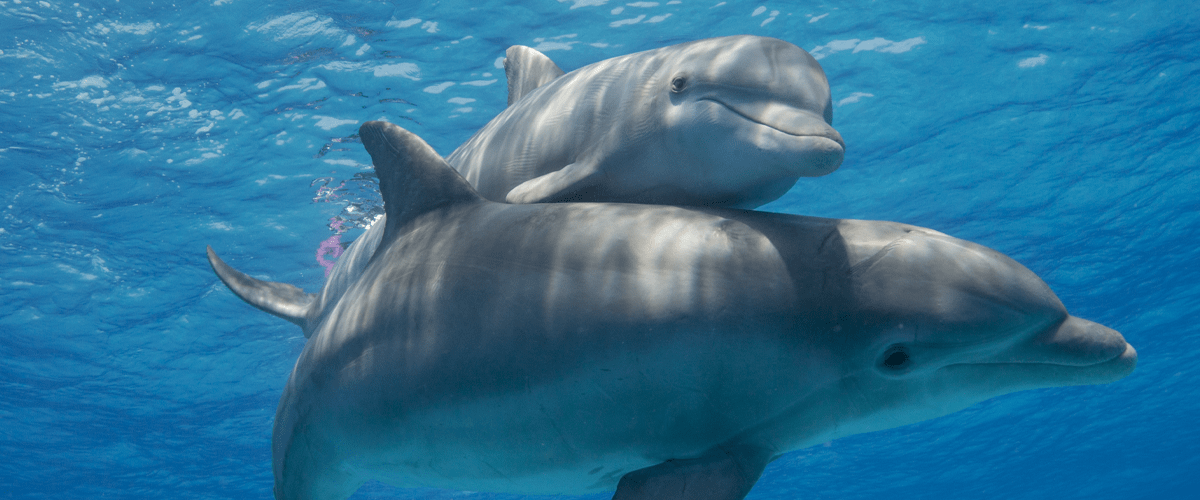

January 13, 2026 – Dolphins are among the smartest, most socially complex animals on the planet. But they’re in trouble. Pollution, disease and human activity are taking a toll, and the clues are showing up in their bodies and their behaviors. Scientists are working to understand what’s happening and how to help.
At Morris Animal Foundation, we’re working to change the story. We fund research that helps uncover the root causes of dolphin health problems, gives scientists better tools to monitor their well-being, and leads to practical solutions that protect dolphins and the ecosystems they rely on.
When you support this work, you help make scientific breakthroughs possible, for dolphins and the oceans we all depend on.
WHAT DOLPHINS CAN TEACH US ABOUT OCEAN HEALTH
More than 40 species of dolphins live in oceans, rivers and coastal waters around the world. Bottlenose dolphins, in particular, are often found near beaches, harbors and other places where people live and work. This makes them easier for scientists to study, but it also means they face more threats from things like pollution, boat traffic and noise.
Because they live so close to human activity, bottlenose dolphins help show us how the environment is changing. They are considered an indicator species, meaning their health can reflect the health of the entire ocean.
If dolphins are getting sick or stressed, it could mean the ocean is in trouble too.
That’s why researchers are focusing on them to better understand emerging threats. In one Foundation-funded study, a team at Georgetown University looked at how disease, stress and human activity affect bottlenose dolphin health. Their work led to better ways to detect illness in wild dolphins. A recent scientific paper from the group, published in ScienceDirect, describes new health markers that can help tell the difference between normal changes and early signs of disease.
This research helps scientists find and address problems sooner and, critically, helps us listen to what dolphins are telling us about the health of the oceans we all share.
WHEN POLLUTION LEAVES A LASTING MARK
Some of the clearest lessons about dolphin health come from environmental disasters. After the Deepwater Horizon oil spill, researchers documented long-term health problems in dolphins living in affected areas, including lung disease, reproductive failure, and weakened immune systems.
Pollution doesn’t just harm wildlife in the moment; it can leave lasting damage in survivors that affects their health for years.
Morris Animal Foundation has supported research that helped uncover how exposure to oil and related pollutants can continue to affect dolphin health long after the initial event. These findings showed that environmental contamination does not only cause short-term harm. It can increase disease risk and reduce survival over time.
The results of this work were published in the journal Endangered Species Research, providing valuable insight into how environmental disasters affect marine mammal health.
By studying dolphins exposed to large-scale pollution events, scientists gain a deeper understanding of how toxic stress impacts marine life, and how similar threats may affect other species, including humans. This work highlights the importance of preventing pollution and responding quickly when ocean ecosystems are damaged.
UNDERWATER NOISE AND CHRONIC STRESS
Sound is essential to how dolphins live. They rely on it to communicate, navigate, find food and stay connected with one another. But human-made noise from boats, construction and shipping can interfere with these behaviors and contribute to long-term stress.
Imagine trying to have a conversation in a room full of jackhammers. Many dolphins live with that level of noise every day.
To better understand this challenge, the Foundation funded a study on how underwater noise affects endangered dolphin populations, particularly its impact on stress and behavior. The study, led by Saliza Awang Bono, MSc, of the MareCet Research Organization, resulted in a peer-reviewed publication in Aquatic Animal Health that explored how chronic noise exposure influences dolphin physiology.
Dr. Bono shared with us that dolphins living in consistently noisy coastal areas often show signs of long-term stress. Over time, this kind of stress can weaken the immune system and increase the risk of disease.
By linking noise exposure to measurable health effects, this research is helping shape strategies that reduce harm and protect critical dolphin habitats.
WORKING TOGETHER TO IMPROVE DOLPHIN HEALTH
In 2025, the Foundation supported an interdisciplinary workshop co-hosted by the National Marine Mammal Foundation and the Cummings School of Veterinary Medicine at Tufts University. The workshop focused on advancing pulmonary health assessment in dolphins and brought together experts in veterinary medicine, human radiology, pulmonology and conservation science.
Bringing experts together helps accelerate progress by improving diagnostic tools and strengthening how science is applied in the field. This work ensures that new knowledge moves quickly from research into real-world use.
HOW YOU CAN HELP DOLPHINS THRIVE
Dolphins can’t tell us what’s wrong. But science can. With the right research, we can catch health problems sooner and protect the waters they call home.
This work is only possible because of donors like you. When you give to Morris Animal Foundation, your donation goes directly to funding research that improves animal health and safeguards the ecosystems they (and we!) depend on.
Your support fuels the next breakthrough. Give today.